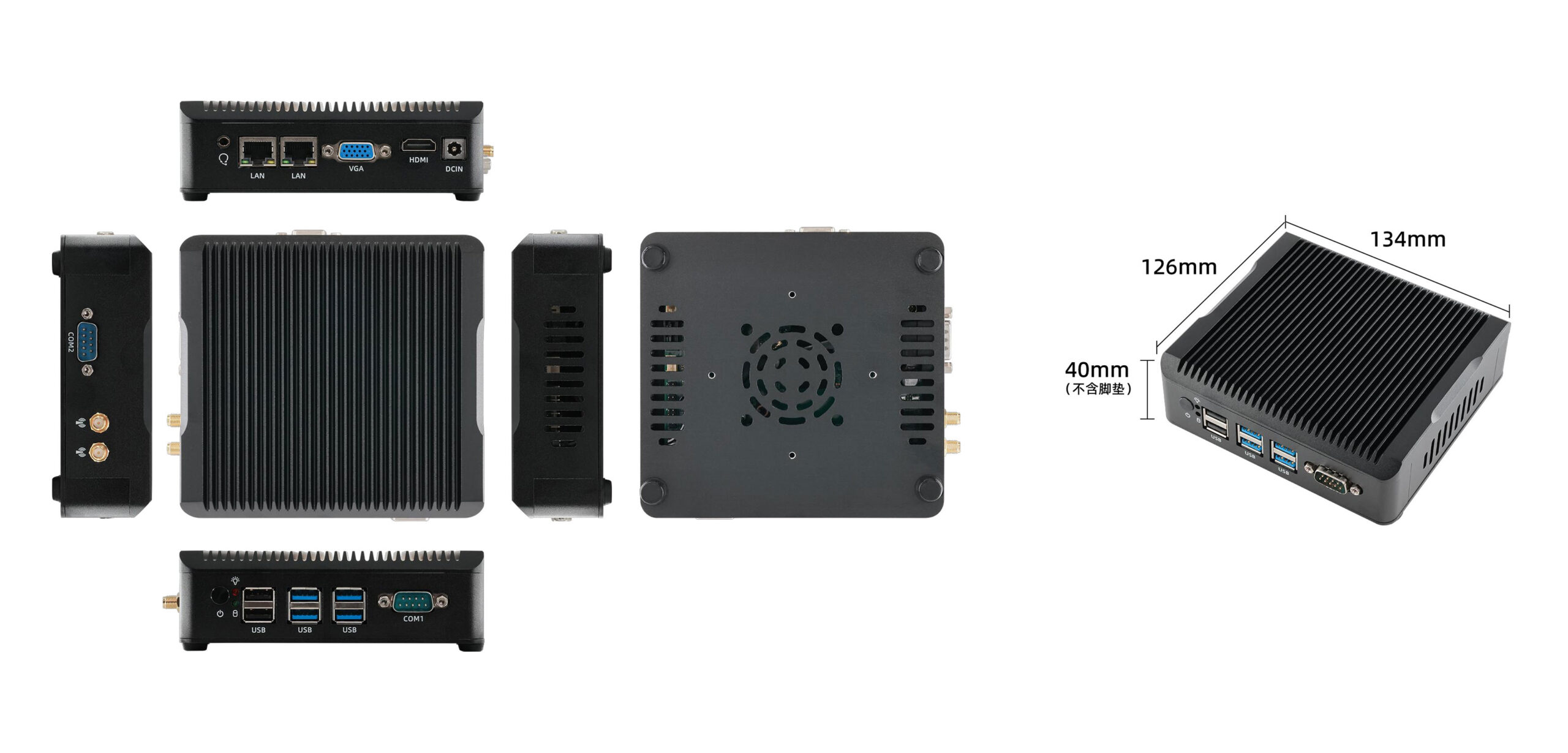
The WF2 fanless industrial mini PC from YCTIPC is a compact, passively cooled embedded computer built for factory automation, machine vision, edge IoT, and control-cabinet deployments. Measuring just 134×126×40 mm and housed in an industrial aluminum alloy chassis, it delivers reliable 24/7 operation from -5°C to 60°C without a single moving part. This guide breaks down the WF2’s specifications, flexible I/O, dual-memory architecture, and real-world applications — and explains why a fanless industrial mini PC is often the smartest choice for space-constrained, dust-prone, or vibration-heavy environments.
What Is the WF2 Fanless Industrial Mini PC?
The WF2 is an embedded industrial computer engineered around a single design goal: dependable computing where a typical office PC would fail. Instead of a spinning fan, it uses the all-aluminum chassis itself as a heatsink, dissipating heat through passive convection. That eliminates the most common point of failure in industrial deployments — the cooling fan — while also keeping dust, debris, and vibration from compromising internal components.
YCTIPC positions the WF2 as an OEM/ODM-ready platform, which means the same chassis can ship with different Intel processors, memory tiers, and I/O configurations depending on the buyer’s application. All specifications below are sourced from the official WF2 product page (accessed 2026-10-06).
WF2 Specifications at a Glance
| Category | WF2 Specification |
|---|---|
| CPU options | Intel Celeron N5095 / N5105; Celeron J1900 / N29 / N28; Pentium N3520 |
| Graphics | Intel UHD Graphics (Gen11) / Intel HD Graphics |
| Chipset | SoC (System on Chip) |
| Memory | 1× DDR4 SO-DIMM (max 16 GB) or 1× DDR3 SO-DIMM (max 8 GB) |
| Storage | M.2 2280 SSD 128/256/512 GB; M-SATA SSD 64/128/256 GB |
| Display | HDMI ×1 + VGA ×1 (dual independent outputs) |
| Network | 2× RJ45 Gigabit LAN (1 Gbps) |
| USB | Config A: USB 3.0 ×4 + USB 2.0 ×2 / Config B: USB 3.0 ×1 + USB 2.0 ×5 |
| Serial / Expansion | 2× RS232 or 1× RS485; Mini PCI-E (full/half-height) with mSATA + 2× COM RS232 |
| Wireless | Wi-Fi 5 / Wi-Fi 6 |
| Audio | Mic-in + 3.5 mm headphone (Realtek HD), 4-pole combo |
| Power switch | 1× Power Switch |
| Chassis | Industrial aluminum alloy, wall-mount capable |
| Cooling | Fanless passive heat dissipation |
| OS support | Windows / Linux |
| Dimensions | 134 × 126 × 40 mm |
| Operating temp. | -5°C ~ 60°C, 30%–98% RH |
| Power input | DC 12V |
Why Choose a Fanless Industrial Mini PC?
A fanless design is not a marketing gimmick — it is a reliability strategy. Industry overviews of passive-cooled industrial computers consistently cite four operational wins that directly reduce total cost of ownership (HYSTOU fanless overview):
- No moving parts to fail. Fans are the first component to wear out in a 24/7 deployment. Removing them extends service life dramatically.
- Dust and debris resistance. Without intake airflow, fine particulates from factory floors stay outside the enclosure, protecting the board and storage.
- Silent operation. Ideal for noise-sensitive spaces such as labs, kiosks, and control rooms.
- Vibration tolerance. Passive mounting has no spinning media or fan bearings to loosen under constant vibration.
For the WF2 specifically, the fanless chassis also enables its remarkably small footprint — at 134×126×40 mm it slides into DIN-rail and wall-mount control cabinets where a fanned box simply would not fit.
Flexible I/O and Industrial Expansion
Industrial projects rarely use a single port type, and the WF2 is built to adapt. It offers two selectable USB layouts so integrators can prioritize either high-speed peripherals (four USB 3.0 ports) or legacy device density (five USB 2.0 ports). Dual Gigabit RJ45 ports support network redundancy, soft-router/firewall duties, or segmented machine-vs-office traffic.
The serial side is equally flexible: choose 2× RS232 or 1× RS485 depending on whether you are talking to PLCs, sensors, or Modbus field devices. A full/half-height Mini PCI-E slot adds mSATA storage plus two more COM ports, and the integrated Wi-Fi 5/6 module removes the need for external wireless dongles in retrofits.
Dual Memory Architecture: DDR4 or DDR3
One of the WF2’s less obvious differentiators is its dual memory architecture. Depending on the chosen platform, the board accepts either a single DDR4 SO-DIMM (up to 16 GB) or a single DDR3 SO-DIMM (up to 8 GB). This lets buyers match memory cost and capacity to the workload: a lightweight IoT gateway or HMI terminal can run happily on economical DDR3, while a data-collection or vision-buffering node can scale up to 16 GB DDR4 — all in the same 134 mm chassis. It is a pragmatic way to hit a target bill-of-materials without redesigning the enclosure.
Where the WF2 Shines: Real-World Applications
The WF2’s combination of small size, flexible I/O, and passive cooling maps cleanly onto several proven use cases:
- Factory automation. Connect PLCs and sensors over RS232/RS485, run an HMI or SCADA edge node, and survive shop-floor dust and vibration.
- Machine vision. Pair the Intel UHD graphics with a Gigabit camera link and local M.2 storage to buffer and preprocess inspection frames at the edge.
- Edge IoT gateways. Dual LAN plus Wi-Fi 6 makes the WF2 a natural protocol bridge between shop-floor devices and the cloud. Edge and IoT deployment patterns for rugged PCs are well documented across the industry (PSB Engineering edge/IoT overview).
- Soft-router / firewall. Two Gigabit ports and a low-power Celeron platform are ideal for a silent, always-on network appliance.
- DIN-rail and wall-mount cabinets. The aluminum chassis and 40 mm height are purpose-built for cramped electrical enclosures.
How the WF2 Compares
Against broader industrial mini PC lineups, the WF2 is deliberately positioned at the compact, cost-efficient end rather than the high-performance end. Competitors often lead with Core i-series processors and extreme temperature ratings down to -40°C; the WF2 instead optimizes for footprint, I/O flexibility, and affordability on proven Celeron/Pentium silicon. That makes it a strong fit when the deployment needs reliable fanless operation and rich industrial I/O, but does not require top-tier compute or arctic-grade certification. Buyers who need the latter should weigh those trade-offs explicitly — a good practice when selecting any industrial computer (Innoda selection guide).
OEM/ODM Customization
YCTIPC offers OEM/ODM customization on the WF2. Because the platform already supports multiple CPU families, memory tiers, storage options, and I/O combinations, a tailored configuration is usually a matter of selecting from existing building blocks rather than a full redesign. Typical customization requests cover CPU grade, memory/storage capacity, COM port type and count, and branding.
Looking for more options? Browse our Industrial PC and Mini PC categories, or return to the WF2 product page for the latest specifications.
FAQ
Is the WF2 truly fanless, and what does that mean for reliability?
Yes. The WF2 uses passive cooling through its aluminum chassis with zero internal fans. This removes the most failure-prone component in continuous operation and prevents dust ingress, which is why fanless industrial PCs are widely used for 24/7 duties.
What operating systems does the WF2 support?
The WF2 supports both Windows and Linux, giving integrators freedom to deploy mainstream industrial software or lightweight Linux-based edge runtimes.
Can the WF2 handle serial industrial devices?
Absolutely. It provides 2× RS232 or 1× RS485 as standard, plus a Mini PCI-E slot that adds two additional COM ports — enough to bridge most PLC, sensor, and Modbus installations.
What is the WF2’s operating temperature range?
The WF2 is rated for -5°C to 60°C at 30%–98% relative humidity, suitable for most indoor industrial and cabinet environments.
References
The external sources cited in this article (all accessed 2026-10-06):
- HYSTOU — Fanless Industrial Mini PC Overview — background on passive-cooled industrial computers and their reliability advantages.
- PSB Engineering — Rugged PC Edge & IoT Deployment — industry patterns for edge and IoT use of rugged PCs.
- Innoda — Industrial PC Selection Guide — practical guidance on choosing the right industrial computer for your workload.
Conclusion
The WF2 fanless industrial mini PC proves that “small” and “rugged” are not mutually exclusive. With its 134×126×40 mm aluminum chassis, flexible I/O, dual DDR4/DDR3 memory options, and proven Celeron/Pentium platforms, it delivers dependable edge computing for factory automation, machine vision, IoT gateways, and control cabinets — without the cost or complexity of higher-tier systems.
Ready to spec your unit? Tell YCTIPC your CPU, memory, storage, and I/O requirements and receive a tailored quotation for your WF2 configuration.